
Yes, we went for a sail!
We got the outboard off the dinghy and hoisted the dinghy onto the foredeck – after a few false starts when there seemed to be too much resistance on the halyard. That halyard is called Syd – there are 2 yellow halyards on the mast and I use Syd, Starboard Yellow Dinghy, to remember which to use for getting the dinghy on and offboard.
All this unusual activity was because we’re booked on the IBA pontoon tonight and tomorrow, so that Takis and his team can do the template for the cockpit cushions tomorrow, Monday.
It’s nearly a week since we left Lefkas, so we needed to head out 2 miles offshore to empty the holding tanks (in harbour, the toilets flush into the 2 holding tanks.) We motored out very slowly while John hauled up buckets of seawater to scrub the mud off the anchor and chain. Mud is good holding for anchors, but unfortunately, it sticks as you bring the chain up into the anchor locker! John was well decorated with mud streaks when he eventually came aft to the cockpit!
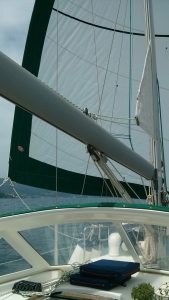
Once we were out of Nidri, there was a light wind and I decided it was time to get the Jenny out (the Genoa, or big foresail.) On the run down from Preveza, we’d had the mainsail out, but we’d only seen the Jenny when we hoisted her onto the furling system on the hard at Cleo.
Some boats are very unbalanced under Jenny alone, but in only 9.5kts of wind just forward of the beam, we made an easy 4kts without any sail trimming. (a Knot is 1 nautical mile per hour, a nautical mile is based on the circumference of the earth and is 1 minute of latitude. It’s slightly longer than a land mile.) She tacked easily (tacking is turning the boat’s bow through the wind, moving the sail to the other side as you head off in the new direction.)
I was once on a sail training weekend in Falmouth, where the instructor simulated engine failure. Having roller reefing Jenny, but no furling on the main, it was easiest to get the Jenny out. We were heading straight for some rocks and then discovered the boat wouldn’t tack under Jenny alone. This was news to the instructor as well – but the engine stayed off. Eventually it dawned on us that we could gybe instead (here you turn the stern of the boat through the wind, also swopping the sail to the other side.) So we did a 270° turn and missed the rocks!
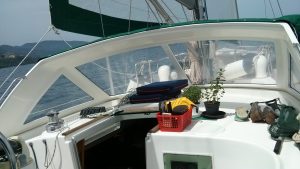
No such problem with LouLouDitsi. After emptying the tanks, we had a slight hiccup when we rolled the Jenny back up under too much tension, so we ran out of furling line before she was fully in. Easily fixed, but a note to ourselves to perhaps put an extra turn or 2 on the furling drum when we hoist the sail next season. Although, we seem to remember MnM saying there’s a downside to doing that …. One to ponder on.
So, a couple of hours after raising anchor in Tranquil Bay, we call up the IBA pontoon on VHF channel 73 and are helped into berth N07. The wind is light, blowing us off, and it’s an easy approach. Nevertheless, it’s a relief that it goes smoothly. Another one under our belt.
I can’t take all the credit for helming into berths – LouLouDitsi is very responsive, has very little prop walk and holds her way well. (Prop walk refers to the fact that when you move a yacht from forwards to reverse, the flow of water between the propeller and the rudder is such that initially, the boat will turn one way, rather than go in a straight line. When you know a boat, you can often use this to your advantage by planning an approach that uses the prop walk to take you where you want to go. But it can be problematic, especially with med mooring which is usually stern-to the quay. In tidal waters, alongside is a more usual mooring, and is generally done going forwards.) I’m used to helming lighter boats with more prop walk and which are more easily ‘caught’ by the wind blowing the bow off to one side or another. In those cases, without enough revs on, it’s easy to lose steering and to have to make an undignified 360° turn to start the approach again. Having more weight underneath (about 9 tonnes) and a different design makes life a good deal easier. We’re so pleased with our choice of boat.
Again, as at Lefkas, we end up too far away from the pontoon for the pasarelle to reach and have to motor ourselves a little closer. I keep meaning to measure it to see if it’s shorter than the usual 2m, but it’s one of many things still on the list!
A sudden heavy downpour just after we arrive, so I take advantage and go round the deck wiping off the accumulations of red dust. After a very hot day, it’s quite refreshing and I’m dry again in minutes.
Showers and hairwashes and soon John’s taking me for dinner to celebrate having the other sail out. One of these days, we may even have both out at once. But let’s not be hasty. We have all the time in the world. Back to my G&T. Cheers, or υγειά μας (yeia mas, pronounced Yamas!)