
As we moor up on the IBA pontoon on Tuesday 25 September, the wind charts for Greece are showing colours (wind strengths) we’ve never seen before. A cyclone is building to the SW of Greece, forecast to move up to the Agean. The wind rushing down to it is forecast to be NE 5 gusting 7 in this area. These Mediterranean tropical like cyclones are often called Medicanes (Mediterranean Hurricanes) although their wind strengths are not hurricane level. This particular one is nicknamed Zorba.

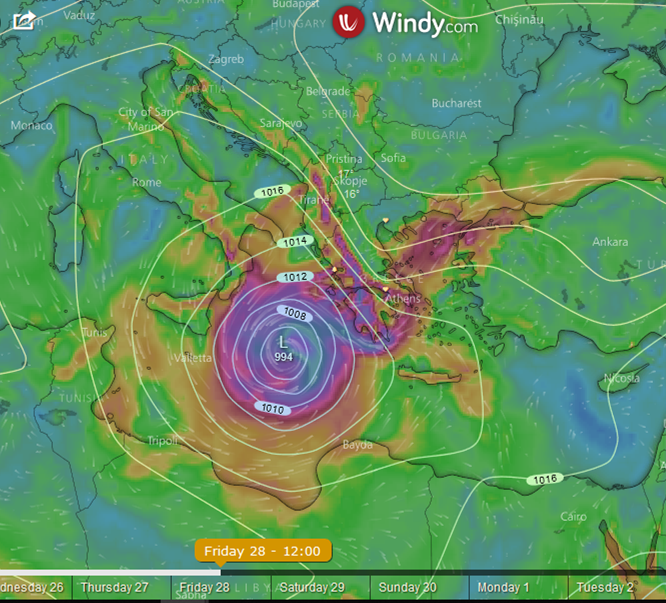
The wind starts around midday on Wednesday. We’ve put on our winter mooring lines with springs in them to absorb the surge, in addition to our regular stern lines. All boats have breast lines at the bow and 2 springs on each side. The IBA staff are constantly checking lines and cleats and provide extra fenders. We note that we’re between 2 larger yachts, which is good because our masts aren’t aligned. If there’s significant movement then aligned masts can hit each other, which is extremely dangerous as it can result in the mast breaking and falling onto people and/or boats.
The wind is exactly from the wrong direction and a swell is beginning to build. The gusts are F7 as predicted – only it’s almost all gusts and no lulls. We’re rolling all over the place. By early evening yachts on the other (North) side of the pontoon start to clash masts. The noise is hideous and terrifying. It would be almost impossible for them to leave safely and not safe to stay onboard, so their crews decamp to the hotel. There’s slightly more protection on the South side where we are. Kelvin, who runs IBA, tells us they will be patrolling the pontoon in shifts all night.
At about 2315 we clash masts with the boat to starboard. Kelvin arrives: “Are you happy to leave?”
“Not really” I say, “but we’re not happy to stay, so we’ll go.” Lifejackets on, start the engine, Nav lights on. I’m ready on the helm as John and the IBA team start taking off the lines (8 of them) until we’re left with the lazyline (which holds the bow to a mooring on the seabed) and 2 stern lines to the pontoon. I’ve put on enough throttle to have some steerage. “How many revs have you got?” asks Kelvin. “About 1700.”
“Tell us when you’re ready, we’ll cast off and you give her everything she’s got.”
My heart is pounding – it’s dark; the wind’s howling; it’s blowing me sideways; if I don’t go out dead straight I’ll get the next boats lazyline round my propeller; we’re rolling all over the place; what if we clash masts on the way out?; I’m terrified; there’s no choice, I have to do this.
“OK, Now!” I shout and push the throttle full ahead. Out, out, keep her straight, now turn quickly to port before the boats anchored ahead, we’re out . . .
Throttle back and potter up into the wind. I can’t see over the sprayhood without standing on tiptoe and can’t see enough through the windscreen. John gets the sprayhood down. There’s a full moon, which helps a lot as we look for a spot to anchor in. All afternoon we’ve watched yachts drag their anchors, re-anchor, sometimes drag again. Some have motored down into Vlikho bay – it’s supposed to be sheltered, but we’ve never been in and are anxious about the unknown in these conditions. And as many yachts are coming out as are going in . . .
Miraculously there’s an obvious space near the pontoons, astern of Lyra of Wight. She’s been there for several days, so we know her anchor’s dug in. We get 50m chain down, which is a good amount in 10m depth. Even at anchor, we’re veering 120° in the wind and the sea that’s built up. We’re lying just off the Nidri Marine pontoon. We watch – is our anchor holding? Is anyone else dragging into us? It’s good to be off the pontoon, but we’re still alert and the adrenaline’s still pumping.
There’s clearly an issue upwind at the entrance to Nidri where a large motor cruiser’s been anchored. He seems to have got his anchor entangled with that of a yacht and at one point is moving towards the ferries, apparently towing the yacht behind him. They separate. And then the motor cruiser zig-zags down the harbour . . .
Phew! He passes downwind of us . . . And then reverses back upwind towards us. We shout and shine a torch on our stern, in case he hasn’t seen us . . . The engine’s still running and I motor towards our anchor, diagonally away from him. Round his stern, his blue lights are incongruous as staff stand with fenders ready . . . He hits us twice on our port side, amidships. There’s a horrible loud cracking noise.
He drops back downwind and I stop motoring forwards. I’m looking at which bit of mud to drive her onto while John goes below to see how big the hole is and to turn on the bilge pump.
“Nothing,” He says, “no hole, no water.” We can’t believe it, it seems impossible. We keep checking, but there’s no sign of water coming in. We later find out that Tony & Pat on Full Flight were anchored upwind of us and they heard the noise when he hits us.
It was just after midnight, only 45 minutes since we’d left the pontoon. We settled down in the cockpit to keep watch, like almost every boat there. How long til sunrise? How long til the wind dies or shifts direction? Check the bilge again. That one’s dragging – he’s not going to try and anchor there, surely? And so we pass Wednesday night.
Remind us why exactly we’re doing this . . . ?