
Didn’t we have fun and games in the forepeak today! And a chemistry lesson thrown in! The reaction produced by applying HCl (Hydrochloric Acid) to carbonate scale in a confined space is really quite something….
At this point I have to confess to those who haven’t already guessed, that this post is about toilet maintenance. Would you have read on under that title? Maybe. Boat owners would’ve known that from the Joker reference and will almost certainly have read on – it’s one of our top topics of conversation, along with batteries & power and the pros & cons of different anchors. There’s much less talk of actually sailing, except for the “storms and gales I have sailed through / been anchored in / heard about” tales, which increase in direct relation to alcohol consumption.
Anyway, boat toilets are not like those at home. They are delicate, fragile systems and need lots of TLC, including a glug of olive oil poured in regularly to keep them running smoothly. Any neglect or mistreatment and they smell, block, backfill with what you last flushed, or just generally stop working. Online forums are a great source of information on diagnosing, repairing and preventing problems, although the threads invariably descend at some point to very basic, very graphic, and sometimes very funny, humour. Just search the ybw forum for Jabsco blocked toilet or Jabsco Joker for examples. I’m going into slightly technical, but not graphic, detail here!
Disclaimer: John’s the engineer, not me. My grasp of chemistry, mechanics, physics and other science stuff is working, but not neccessarily complete or accurate. I find my own way to understand the bits I need to know. One day, John may post an engineer’s view of these events (when he’s stopped researching and fixing stuff, he says!) Until then, please consider your blood pressure and don’t get too upset if anything’s not quite right.
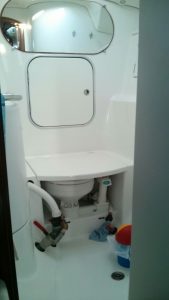
On yachts, the heads (actually refers to the toilet, but often used to mean bathroom) are crammed into whatever awkward space is available after everything else has been put in. Each toilet has at least 2 plastic pipes: an inlet pipe to let sea water in for flushing and an outlet pipe to let waste leave the boat through a skin-fitting (hole!) below the water line.
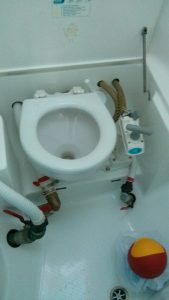
These days, there may also be a “holding tank” which holds waste until you’re at least 2 miles offshore and can pump out. In the Med this is usual, in some countries it’s a legal requirement. A holding tank means more pipes. All these pipes invariably have to take circuitous routes through the awkward space around the toilet, so they are often long and difficult to remove or change.
We have 2 heads, both with holding tanks. There’s a Y valve (junction box) to select whether you pump out to the tank or to sea. In some places we would pump everything to the tank, in others it’s “wee to sea and what’s rank to the tank.” The key thing is not to overflow the tank in harbour – it’s unpleasant, unsociable and embarrassing. The temptation therefore, is to use as little water as possible for flushing. Wrong! Or, at least, you can, but that brings its own problems . . .
Salt water and urine combine to produce hard scale. This builds up, narrows the pipes and causes blockages. The recommendation is 7 pumps per metre of pipe, to ensure that only seawater is left sitting in the pipes, so no scale will build up.
Aft, we have 2m of pipe to flush to sea, so minimum 14 pumps. In the fore heads we have 2.5m, so 18 pumps. In practice, we do a minimum of 20 pumps to sea in both. No problem.
Pumping to the holding tank means 3m / 21 pumps in the aft heads. In the fore heads it’s 2m / 14 pumps. Like this, it’s easy to fill the holding tank really quickly, so many boats use fewer pumps and take preventative measures against scale build up.
The forward heads was back filling. Not nice. Ah, we thought – the Joker valve needs changing, classic problem. The Joker should allow waste to flow out of the toilet as it’s pumped, and stop it flowing back in again. That’s very over-simplified, so do an online search if you want more accuracy. There are various theories as to why it so named. The most convincing I’ve read is from Vyv Cox, who gives invariably sound advice in yachting mag columns and on technical forums. He gave a really useful presentation at the CA Med section seminars in March. He says it was going to be called a ‘choker valve’ but the name was registered in hydraulics technology. So they called it a Joker valve.
Off we go to buy a Joker and a couple of spares. In fact, we buy 2 service kits, which include the Jokers, so we’ll know everything’s OK. Another 90 euros.
John replaced the Joker and other gaskets, seals etc. and everything seemed to be fine. Then it wouldn’t pump properly, started backfilling again, and from time to time flushed in, but not out, meaning that the bowl just kept filling. Back to search the forums again.
It seems that we probably have a build up of salts in the pipes. This may also have caused the Joker to invert, hence the back-filling. The answer is to remove the pipe and bang it hard on the quay or pontoon to smash the scale, which can then be pushed out with a long bendy object. Even better, replace with new pipe.
Getting the pipe out and a new one in will be very tricky.
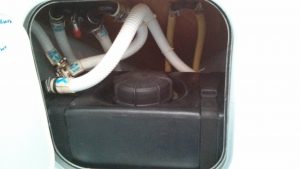
It goes under the tank, up behind it and then down again to the Y valve. Along with lots of other pipes. It’s a long shot, but we decide to try the preventative treatment. A few people (but not many) report success with this to clear an existing build up.
This requires Hydrochloric Acid. A dilute version is available in the UK as brick cleaner, but it’s widely sold throughout Europe for 1 euro a bottle. Then we remember the 3 red plastic bottles in the under sink cupboards of the heads. We hadn’t yet got around to deciphering the Greek characters on these, but further inspection did indeed spell out what was clearly HCl.
Vyv Cox’s online advice is to pour the whole bottle in, wait til the fizzing stops and then pump a few strokes so it sits in the pipes. Leave for 30 mins and pump out fully.
The HCl reacts with the scale or salts, like magnesium carbonate, creating a lot of fizzing and producing CO2, water and a mixture of magnesium and calcium chlorides, which are present in seawater. So environmentally harmless.
We pour it in and watch a very brief, barely noticeable fizz. So we pump a few strokes to push the HCl up the pipes.
BANG! CRACK! WHIZZ! FIZZ! BANG! CRACK! WHIZZ! FIZZ!
reverberates around the small cupboard in which the tank sits. It’s really loud and just keeps going. I’m terrified the flexible plastic pipe will burst and we’ll both be sprayed with acid and who knows what else. Or that it will blow a hole in the hull. None of this happens, but the firecrackers continue. We go up onto the foredeck and peer over the port side, roughly where the outlet sits below the waterline – definite bubbles, CO2 presumably.
Eventually, we settle and wait for it to stop before pumping a bit more. But the show’s over for tonight.
Perhaps the pumping’s easier than it was? Wishful thinking probably. Maybe we’ll buy some more and try another bottle . . . . Something clearly happened in the forepeak today . . . .
Two suggestions:
1. Use the “bucket and chuck-it” method.
2. Eat lots of really strong curries – though that may also do the pipes in.
1. Bucket and chuck-it disallowed on grounds of
a) unreliable with a centre cockpit.
b) easier for some than others – doesn’t meet onboard gender equality policy 😉
c) not a multi-purpose solution. No further detail required, thank you!
2. Already eating lots of curries for heat and mozzies. Ineffective on carbonates, apparently.
Appreciate the suggestions, though!